On this page
- How to Layer Necklaces: The Two-Inch Rule
- Necklace Lengths, Explained: Choker to Rope
- The Three Formulas That Always Work
- How to Layer Necklaces With a V-Neck
- How to Layer Necklaces With a Crew Neck
- How to Layer Necklaces With a Scoop Neck
- How to Layer Necklaces With a Square Neck
- How to Layer Necklaces With a Turtleneck
- How to Layer Necklaces With a Strapless or Off-the-Shoulder Top
- How to Layer Necklaces With a Button-Down Shirt
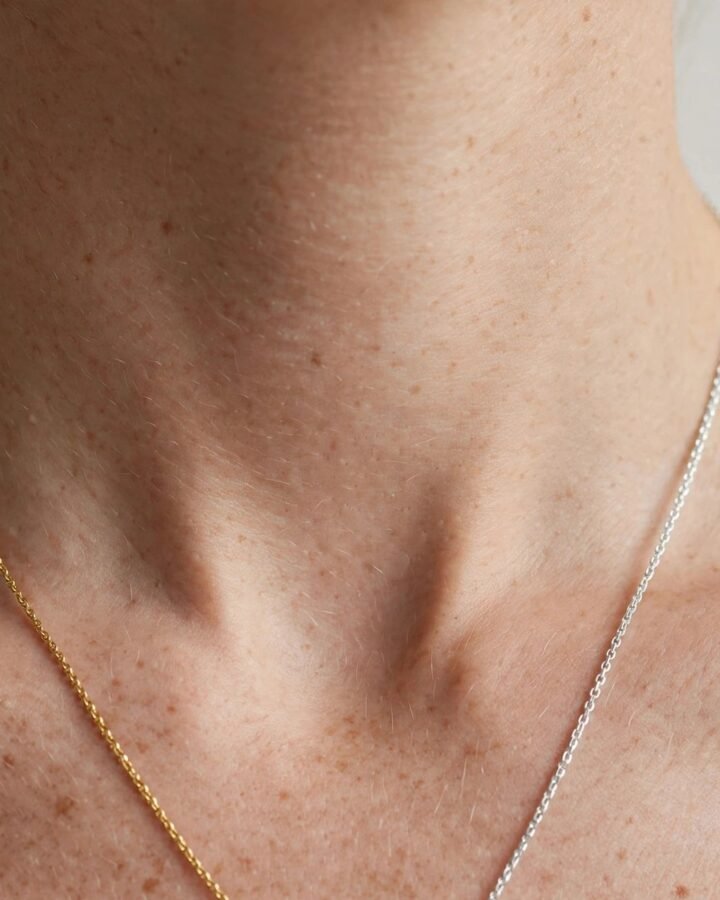
- Mixing Metals and Chain Textures
- How to Stop Layered Necklaces Tangling
- Layering for Your Frame: Petite, Tall and Fuller Bust
- Layering Necklaces With a Leather Jacket
- Everyday vs Occasion Stacks
- Where to Buy Layering Necklaces That Last
- Frequently Asked Questions
- Final Word
Learning how to layer necklaces is mostly learning one number: two inches. Keep at least two inches between every chain in the stack, give each piece its own visible lane, and almost any combination looks deliberate. Ignore the spacing and even expensive necklaces collapse into a tangled knot that reads as an accident. This guide covers the exact lengths, the three formulas that always work, and the right stack for every neckline — V-neck, crew, scoop, square, turtleneck, strapless and collared shirts — so you can build a layered look that suits your outfit, your frame and your metal.
How to Layer Necklaces: The Two-Inch Rule
Every good layered stack follows one principle: each chain needs its own visible lane. The practical translation is a minimum of about two inches of difference between adjacent chains, measured in total chain length. A clean three-piece stack reads as 16 / 18 / 20 inches, or 16 / 18 / 22. A two-piece stack might be 16 / 20, so the pendant on the longer chain has room to sit alone.
Anything closer than two inches between chains and they will tangle by lunchtime, every time. The chains sit on top of each other, rub together as you move, and by the afternoon they have knotted into one thick line. Two inches is a hard minimum, not a suggestion — and if you have a shorter neck or a fuller bust, spread the layers a little wider, three inches instead of two, so the stack reads as separate lines rather than a cluster.
The second half of the rule is weight. Go from delicate to bolder as you go down: the shortest chain should be the finest, and the longest chain can carry the most visual weight. A heavy chain at the top with a fine chain below it looks upside down, because the eye expects the longest piece to be the one that earns the extra length. Keep the top layer plain or nearly plain, give the middle layer a small detail — a bar, a tiny charm, a station of stones — and let the longest chain carry the piece you actually want people to notice: a birthstone pendant, a locket, a personalised charm.
Necklace Lengths, Explained: Choker to Rope
Jewellers use a small set of traditional names for necklace lengths, and knowing where each one sits on the body makes it much easier to plan a stack instead of guessing at checkout. The same numbered length lands differently depending on neck circumference and torso length, so treat the table as a starting point rather than a promise.
A choker is 14 to 16 inches and sits snugly at the base of the neck. It is the highest layer in most stacks, and it is the piece that frames the whole look. A princess length is 17 to 19 inches and rests on or just below the collarbone — the most versatile length of all, and the workhorse middle layer of almost every stack. A matinee is 20 to 24 inches and falls between the collarbone and the bust; it is the length that carries a pendant best. An opera length is 28 to 36 inches and hangs at or below the bust, elongating the torso and giving a statement pendant real presence. A rope is 36 inches and up, long enough to loop twice or knot, and it is the dramatic layer — one rope doubled gives you an instant two-piece stack on its own.
The combination that works under almost any outfit is choker plus princess. Add a matinee length for evening wear, or when you want the stack to be the actual focal point rather than a background detail. Opera and rope lengths are for when the necklace is the outfit’s main event, not an accent.
The Three Formulas That Always Work
Once the spacing is sorted, the composition is about contrast — in length, in visual weight, and in what each chain is doing. Here are the formulas to copy, in order of difficulty.
The two-piece starter is where everyone should begin: one plain chain at 16 inches, one pendant necklace at 18 to 20 inches. The bare chain frames the neck, the pendant becomes the focal point, and nothing competes. It works with a T-shirt, a work blouse and a going-out top, and it takes ten seconds to put on. If you only ever learn one stack, learn this one.
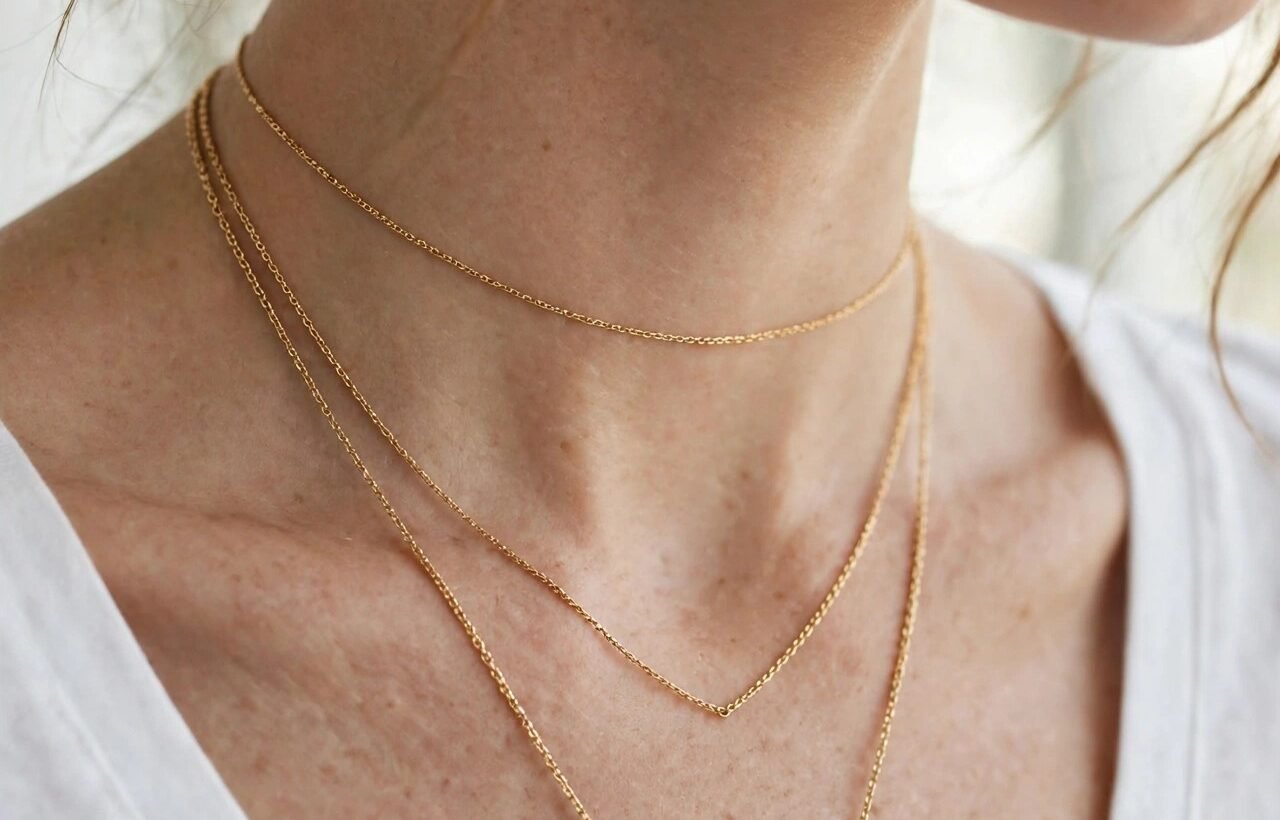
The classic three is short, medium, statement: 16 / 18 / 20–22 inches. Keep the top layer delicate and unadorned, give the middle layer a small detail, and let the longest chain carry the piece you want people to notice. This is the stack in our featured photo — choker, princess and a matinee with a round pendant — and it is the most photographed combination in jewellery styling for a reason: it reads as complete without reading as busy.
Four or more layers need grouping. Long stacks look intentional when you stop thinking of them as four separate necklaces and start pairing them: two close-set fine chains at the top (16 and 18 inches), then two spaced longer pieces below (20 and 24 inches, or a matinee and an opera). The pairs read as two deliberate groups instead of four competing lines. Past four pieces, the risk flips — the stack stops looking layered and starts looking like clutter, so four is the practical ceiling for most outfits.
How to Layer Necklaces With a V-Neck
A V-neck is the easiest neckline to layer with, because the neckline itself tells you the shape: follow the V. Layers that echo the V, ending in a pendant that sits just inside the point of the V, look beautiful and deliberate.
The formula is a choker at 16 inches, a princess at 18 inches, and a matinee pendant at 20 to 22 inches that lands just above the V’s point — or just below it, sitting on the fabric. The one position to avoid is the near miss: a pendant that brushes the edge of the V looks like it is trying to match the neckline and failing. Pick a side. The chain is either clearly inside the opening, well clear of the lowest point of the edge, or clearly below it, lying on the fabric. A gap of roughly two to three centimetres either way is where the accidental look starts.
V-necks are also where a pendant earns its keep. A plain chain stack on a V-neck can look unfinished, because the open V is a big empty space; one pendant at the bottom of the stack fills it. Keep the pendant small — a coin, a stone, a locket — because a large pendant plus a deep V competes with the neckline instead of completing it.
How to Layer Necklaces With a Crew Neck
A crew neck is the hardest common neckline to layer with, because the round edge sits close to the base of the neck and covers most of the chest. Short chains get lost against the fabric, and the princess length — 17 to 19 inches — is the one most likely to graze the seam and sit half on skin, half on cloth.
The answer is to go short or go long, never in between. A choker at 14 to 16 inches clears the neckline from above and sits on bare skin, which works with a crew neck T-shirt. Or a matinee length at 20 to 24 inches lands cleanly on the fabric below the collar, which works even better — a single fine chain at matinee length is the easy answer if you wear a tee all year. What does not work is a stack that tries to sit in the middle: two or three chains bunched around the collar edge will look tangled even when they are not.
If you do want a stack with a crew neck, keep it to two pieces — a choker and a matinee — with the wide gap between them doing the work. And keep the chains on the fabric, not half on skin: once a chain crosses the collar edge it stops reading as layered and starts reading as caught.
How to Layer Necklaces With a Scoop Neck
A scoop neck is a curve, so the chain wants to echo it. A princess length drawn inside the scoop repeats the shape, and a pendant that sits just inside the lowest point of the scoop looks deliberate — like the necklace was made for that top.
The formula is a choker plus a princess: a fine chain at 16 inches and a pendant chain at 18 inches, both sitting inside the open curve. The scoop gives you a framed space, and two layers fill it without crowding it. A third layer at matinee length can work too, but only if it sits clearly below the scoop’s edge on the fabric — if it hugs the curve it crowds the other two.
What to wear: a choker and a pendant necklace in the same metal, the pendant small enough to sit inside the scoop without touching the fabric. If the scoop is deep, the pendant can be a little larger; if the scoop is shallow, keep everything fine and short. And if you are choosing the metal, our gold vs silver jewelry guide settles it by skin undertone — warm skin glows in gold, cool skin shines in silver — so the stack matches the skin it sits against, not just the top.

How to Layer Necklaces With a Square Neck
A square neck is a straight line across the chest, and it rewards a different geometry from a scoop: horizontal lines. A choker that follows the straight edge, plus one princess-length chain sitting just below it, mirrors the neckline’s shape and looks architectural rather than soft.
The formula is two layers, both short: a choker at 14 to 16 inches and a princess at 17 to 19 inches, with a small pendant on the lower chain if you want a focal point. Keep the pendant centred — a square neckline is symmetrical, and an off-centre pendant fights it. Avoid long chains here: a matinee or opera length hanging down from a square neckline ignores the shape entirely and pulls the eye away from the frame the neckline is making.
Square necks are also a good place for a bar necklace or a horizontal pendant, because the straight line of the piece echoes the straight line of the neckline. It is one of the few necklines where the pendant’s shape matters as much as its length.
How to Layer Necklaces With a Turtleneck
A turtleneck covers the neck entirely, so short chains are pointless — they disappear into the knit or sit bunched at the collar. With a turtleneck, the rule flips: go long, and wear the necklace on top of the fabric.
One longer piece at 24 inches or more, worn over the knit, is the classic answer. A single opera-length chain with a pendant reads as intentional and elegant, because the turtleneck is a plain backdrop and the necklace is the only jewellery in the frame. Two layers can work — a 24-inch chain and a 28- to 30-inch chain — but both must sit on the fabric, clearly below the collar, and the pendant must be heavy enough to hang straight against the knit instead of sliding around.
Silver is the natural choice over a black turtleneck: the bright, cool metal cuts through the dark knit and reads clearly from a distance. Gold works better over cream, camel or brown knits, where its warmth matches the fabric. Either way, keep the chain fine — a heavy chain on a turtleneck looks like hardware, not jewellery.

How to Layer Necklaces With a Strapless or Off-the-Shoulder Top
Strapless and off-the-shoulder tops give you the most bare skin of any neckline, which means the most room to layer — and the most room to get it wrong. With this much skin showing, three fine layers can look delicate and romantic; three heavy layers look like armour.
The formula is a choker plus one or two delicate layers: a fine chain at 16 inches, a princess at 18 inches, and, if you want a third, a matinee at 20 inches with a small pendant. Keep every chain fine — 1 to 1.5mm at the top, no more than 2 to 3mm at the bottom — because the skin is doing the visual work and the jewellery should trace it, not cover it.
This is also the neckline where a statement choker earns its place. A slightly bolder choker — a tennis-style line of stones, or a thicker chain — with one fine layer below it looks evening-ready in a way a stack of equal chains never does. And because the shoulders are bare, the necklace is the outfit’s frame: if you are wearing earrings too, keep them small, so the neck gets the attention.
How to Layer Necklaces With a Button-Down Shirt
A collared shirt changes the question, because the collar is already a frame. The trick is to decide whether the necklace sits inside the collar or outside it — and then commit.
With the top button undone, a choker and a princess chain sitting inside the open collar look sharp and intentional, especially with a pendant that lands just below the collar points. With the shirt buttoned up, skip the short layers entirely and wear one longer chain — matinee or opera — over the shirt, the way you would with a turtleneck. A short chain under a buttoned collar bunches at the neck and looks trapped.
For work, the button-down stack should be quiet: two fine chains, one metal, no large pendant. Our beginner cosplay guide makes the same point about character outfits — one statement piece, plain everything else — and it holds for the office too. Save the three-layer stack with a bold pendant for after work, when the shirt is open and the necklace can breathe.
Mixing Metals and Chain Textures
Mixing metals in a layered stack works, but only when it looks deliberate — the same rule that governs mixing gold and silver anywhere. Let one metal lead, about 70% to 30%, and keep the finishes similar: polished gold with polished silver works, matte gold with high-shine silver does not, because the contrast in finish is louder than the contrast in colour.
The easiest way to mix is to let the stack do it for you: a two-tone chain, a mixed-metal pendant, or a gold chain with a silver charm all read as one designed piece. Gold earrings with a silver necklace, worn far apart, read as two different outfits — so if you are mixing, mix at the same place on the body.
Chain texture is the other half of contrast. A stack of three identical cable chains looks flat, even at perfect spacing. Mix a fine cable chain with a paperclip chain, a rope chain, or a beaded chain, and the stack gains depth without gaining weight. The rule is one textured chain per stack — two textured chains compete, and three look like a hardware drawer. A satellite chain, with its small spaced beads, is the safest texture to add: it reads as detail, not bulk.
How to Stop Layered Necklaces Tangling
Tangling is the number one reason people give up on layering, and it is almost entirely preventable. The first fix is the spacing rule — two inches minimum between layers — because chains that sit on top of each other will knot. The second fix is weight order: heavier chains below, finer chains above, so gravity pulls each chain into its own lane instead of dragging them together.
The third fix is a layering clasp. It is a small bar with two or three separate clasps that holds all your chains at the back of the neck, spaced apart, so they cannot twist around each other. It costs a few dollars, it turns three separate necklaces into one unit, and it is the single best purchase for anyone who layers more than twice a week. Put the longest necklace on first and the shortest last, so each chain settles over the one below it instead of under it — and fasten each clasp before adding the next chain.
Storage matters as much as wearing. Never toss layered necklaces loose in a box: hang them, or lay them flat in separate compartments, or keep each chain in its own small pouch. A chain that goes into a drawer tangled comes out tangled, and no amount of careful wearing fixes a knot that started in storage. For the same reason, take layered necklaces off in reverse order — shortest first — and lay them down separately, not in a pile.
Layering for Your Frame: Petite, Tall and Fuller Bust
The same stack lands differently on different frames, and the adjustment is mostly about spacing and length, not about buying different necklaces.
Petite frames and shorter necks look better with tighter combinations — a choker plus a princess, 16 and 18 inches — because anything past 20 inches can visually overwhelm a smaller frame and shorten the torso. If you are petite and you love a long pendant, wear it as a single piece, not as the third layer of a stack, so it gets the space to itself.
Taller frames can handle the full combination — choker, princess and matinee, 16 / 18 / 22 — without it reading as busy, because there is more torso for the layers to spread across. A rope length doubled also works better on a taller frame, where it has room to hang instead of pooling at the waist.
A fuller bust changes the geometry: a matinee or opera chain will rest on the bust instead of hanging straight, which shortens its effective length and can push the pendant sideways. The fix is wider spacing — three inches between layers instead of two — and shorter overall stacks, so the longest chain clears the bust instead of sitting on it. Our body shape outfit guide explains how neckline and proportion change what jewellery reads best, and the same logic applies here: let the frame choose the lengths.
Layering Necklaces With a Leather Jacket
Jewellery with a leather jacket is a different question from jewellery on bare skin, because the jacket is doing half the work. A black leather jacket is a strong, dark frame, and a necklace has to hold its own against it — which is why this is one of the few places where a single bold layer beats a delicate stack.
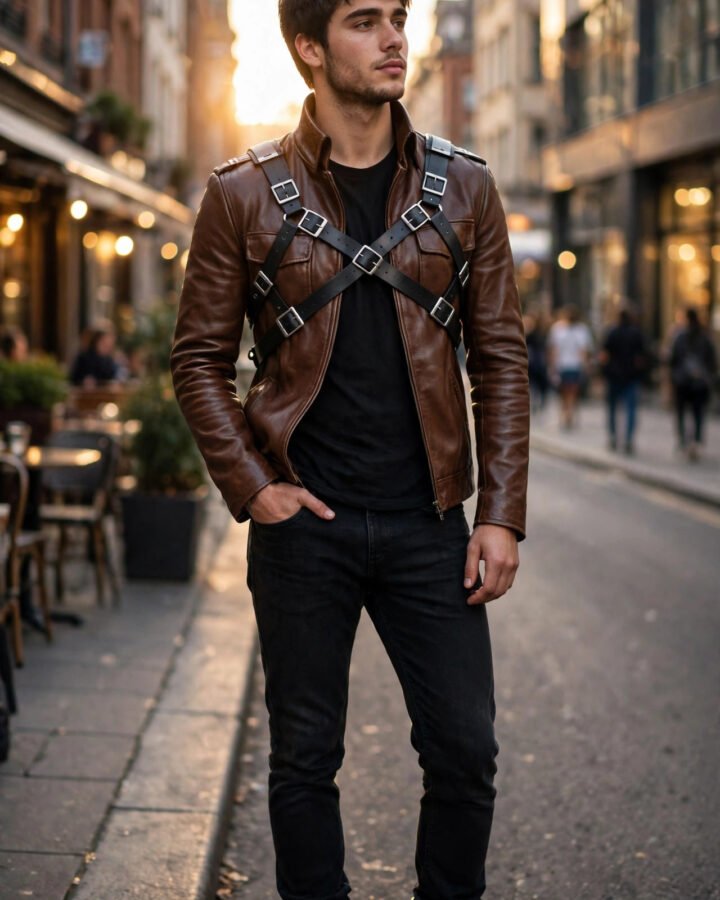
Silver wins with a black leather jacket most of the time. The bright, cool metal cuts through the black leather and reads clearly from a distance — a silver chain over a black jacket pops in a way gold sometimes does not. The formula is one or two layers: a silver chain at princess length, or a choker plus a matinee pendant, worn with the jacket open so the necklace sits against skin, not leather. Gold wins with a brown leather jacket, where its warmth matches the leather — a gold chain over a brown bomber looks intentional and rich where silver can look cold and separate.
One strong piece, not five. A leather jacket is already a statement, so add one necklace or one pair of earrings, not a full set — the jacket is the outfit, and the jewellery is the accent. If you are buying the jacket itself, our guide to the best leather jackets for men rounds up the cuts that take jewellery well, and a long coat takes a longer chain than a short jacket — the difference is explained in our leather coat vs leather jacket guide. For the rest of the outfit, our anime jackets roundup leans on the same combination: dark jacket, bright metal, one strong piece.
Everyday vs Occasion Stacks
For everyday wear, keep the stack to two pieces and keep the metal the one that suits your skin — sterling silver for cool skin, 14k gold for warm skin, because both are hard enough for daily wear and, in gold’s case, never tarnish. Small studs, a fine chain and one pendant you never take off: that is the everyday stack, in whichever metal your skin prefers. If you want a second opinion on the metal before you buy, our outfit color matching tool walks through the same warm-versus-cool logic for your whole wardrobe, not just your jewellery.
For occasions, you can be bolder. A three-layer stack with a statement pendant, a tennis-style choker, or a mixed-metal set all work when the outfit has enough else going on to carry them. The rule is the same as with any jewellery: the more formal the outfit, the more freedom you have. A black evening dress carries a full stack easily; a work blouse does not.
For work, keep it to one metal and keep it quiet. A single fine chain or a pair of small studs in your skin’s metal reads as polished; three layers and a large pendant read as a night out. If your workplace is formal, silver and white gold read as slightly more conservative than yellow gold.
Where to Buy Layering Necklaces That Last
Buy the lengths, not the picture. Before you order a stack, check the actual chain length in inches — not “short”, “medium” or “long” — and check whether a gold-toned piece is plated, vermeil or gold-filled, because a plated chain in a stack wears through fastest: it rubs against the other chains all day. Gold-filled and sterling silver are the finishes that survive layering, and they are worth the extra money for pieces you will wear every day. When you are working out whether a piece is worth its price, our cost-per-wear calculator turns the price and how often you will wear it into a real number — a $40 gold-filled chain worn 200 times costs less per wear than a $15 plated one worn 20 times.
Our own shop, Belvurra Jewelry, makes handmade mystery jewelry pieces — layered necklace sets, pendants, chains and statement pieces in gold and silver tones — and it is the place to start if you want a stack you have not seen a hundred times already. Every order includes a mix of pieces, so it is also the easiest way to try different lengths and metals and find out which combination your neckline actually prefers, without committing to one expensive set first. If you are building a small jewellery wardrobe from scratch, start with one choker, one princess chain and one pendant — and use our capsule wardrobe planner to keep the whole collection to pieces you will actually wear.
Frequently Asked Questions
How many necklaces should I layer at once?
Two or three. Two is the easiest place to start and the most wearable every day — a plain chain and a pendant chain. Three is the classic full stack — short, medium, statement. Four can work if you group them in pairs, but past four the stack stops looking layered and starts looking like clutter.
How much space should I leave between layered necklaces?
At least two inches between adjacent chains, measured in total chain length — for example 16, 18 and 20 inches, or 16, 18 and 22. Anything closer tangles by lunchtime. If you have a shorter neck or a fuller bust, use three inches between layers instead.
What lengths do I need to layer necklaces?
A choker at 14 to 16 inches, a princess at 17 to 19 inches, and a matinee at 20 to 24 inches will cover almost every stack. Add an opera length at 28 to 36 inches for evening or for wearing over a turtleneck. Those are the standard trade names, so they are useful when browsing or asking a jeweller.
Can I layer necklaces with a crew neck?
Yes, but go short or go long, never in between. A choker at 14 to 16 inches sits on bare skin above the collar, or a matinee at 20 to 24 inches lands cleanly on the fabric. The princess length at 17 to 19 inches is the one most likely to graze the crew neck’s seam and look caught.
How do I stop layered necklaces from tangling?
Keep at least two inches between layers, put heavier chains below finer ones, and use a layering clasp — a small bar that holds all your chains spaced apart at the back of the neck. Put the longest necklace on first and the shortest last, and store each chain separately instead of tossing them in a box together.
Can I mix gold and silver necklaces in one stack?
Yes, if it looks deliberate. Let one metal lead, about 70% to 30%, mix at the same place on the body, and keep the finishes similar — polished with polished. A mixed-metal chain or pendant reads as one designed piece; gold earrings with a silver necklace worn far apart reads as two different outfits.
What necklace length goes with a V-neck?
Follow the V: a choker at 16 inches, a princess at 18 inches, and a matinee pendant at 20 to 22 inches that lands just inside the point of the V. Avoid the near miss — a pendant that brushes the edge of the V looks accidental. Either sit clearly inside the opening or clearly below it on the fabric.
Final Word
How to layer necklaces comes down to two inches and one decision: the neckline decides the lengths, and the lengths decide the stack. Keep two inches between every chain, go from delicate to bolder as you go down, and let the neckline tell you whether to go short, long, or both. A choker, a princess and a matinee will carry you through almost every outfit you own — and once the spacing is right, the rest is just choosing pieces you actually love.