
On this page
- The Five-Point Leather Jacket Fit Test
- Shoulders: The One Measurement That Cannot Be Fudged
- Chest: Zip It Up Before You Judge It
- Sleeves: End at the Wrist Bone
- Waist and Hem: Length Is a Style Decision
- Movement: The Test That Catches Everything Else
- Too Tight or Too Loose? The Signs at a Glance
- Fit by Style: Biker, Bomber, Café Racer and Oversized
- Men's Fit vs Women's Fit
- Will Leather Stretch? What Breaking In Really Does
- Between Sizes: Size Up or Size Down?
- Trying It On: The Five-Minute Check
- Where to Find Leather Jackets That Fit
- FAQ: How Should a Leather Jacket Fit?
How should a leather jacket fit? It should sit cleanly across your shoulders, close comfortably around your chest, and let your arms move without pulling at the back. The sleeves should finish at the wrist bone, the hem should match the jacket's style, and the whole thing should feel close — not restrictive. That is the short answer. The longer answer is a five-point test you can run in two minutes, in a shop or in front of a mirror at home, and it will save you from the most common leather-jacket mistake of all: keeping a jacket in the wrong size because it looked fine unzipped.
Leather is less forgiving than most fabrics. A hoodie stretches, a blazer can be tailored, but a leather jacket that is too tight across the shoulders will stay too tight, and one that is too big will always look borrowed. The good news is that fit is not a mystery. Four areas decide it — shoulders, chest, sleeves, length — plus one movement test. Get those five right and the jacket will look like it was made for you, because in every way that matters, it fits like it was.
The Five-Point Leather Jacket Fit Test
Before the details, here is the whole test in one place. Zip the jacket up, stand naturally, and wear the kind of layer you expect to put underneath it — a t-shirt in summer, a sweater in winter. Then check these five things.
First, the shoulders: the seam should sit on the edge of your natural shoulder, where the flat top turns down into your arm. Second, the chest: zipped up, the front should lie smooth with no X-shaped pulling at the zip, and you should be able to slide a flat hand between the jacket and your chest. Third, the sleeves: the cuff should end at the wrist bone, with about a centimetre of shirt cuff showing. Fourth, the hem: a biker or café racer should finish at the belt line, a bomber at the top of the hip. Fifth, movement: reach forward, raise your arms, sit down — the jacket should resist a little when new, but never dig in or force the zipper to strain.
If all five pass, the jacket fits. If one fails, the rest of this guide tells you whether it is a deal-breaker or a style choice, and whether to size up, size down, or walk away.
Shoulders: The One Measurement That Cannot Be Fudged
If you can only get one area right, make it the shoulders. Everything else on the jacket hangs from them, and shoulder width is the hardest thing to alter in leather. A tailor can shorten a sleeve or take in a waist; moving a shoulder seam on a leather jacket is major surgery, and on most jackets it is not worth doing.
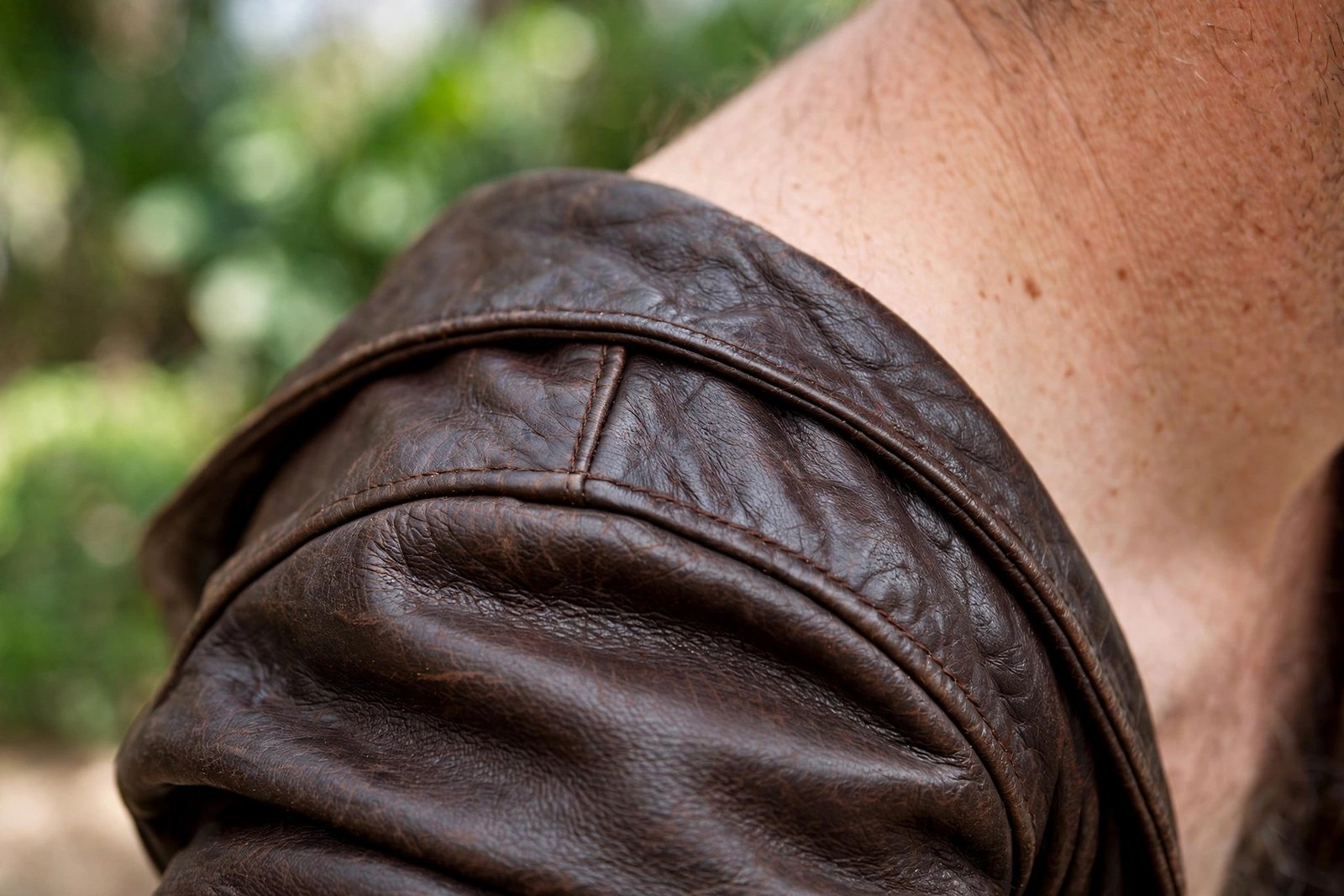
The shoulder seam should sit exactly where your shoulder ends and your upper arm begins — on the edge of the shoulder bone, where the flat top of your shoulder turns down. Stand in front of a mirror with your arms relaxed at your sides and look at the seam. On a classic fitted jacket it should sit on that edge, not past it and not short of it.
A seam sliding noticeably down the upper arm means the jacket is too large, unless the jacket is deliberately designed with dropped shoulders — an oversized or relaxed style where the seam sits past the shoulder on purpose. Know which one you are buying. On a regular biker, bomber or café racer, a dropped seam means the shoulders are wrong, and the jacket will look borrowed no matter how well the rest fits.
A seam pulling toward your neck means the jacket is too small. You will usually see a diagonal drag line running from the shoulder seam toward the chest, and the sleeve will pull when you reach forward. This is the fit fault that never improves with wear: leather relaxes a little where it flexes, but shoulder width does not change. If the shoulders are too narrow on day one, they will be too narrow in a year.
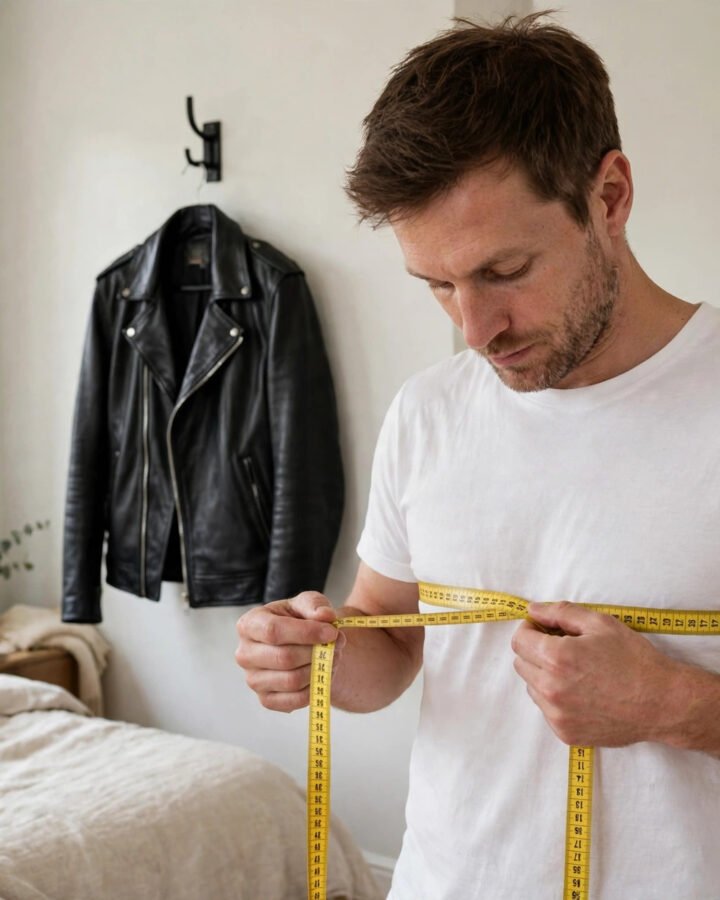
One more check that catches what the mirror misses: reach forward as if you are holding a steering wheel. If the back panel pulls tight across your shoulder blades, or the shoulders resist the reach, the jacket is too narrow across the back — and breaking it in will not fix that. Our guide to how to measure yourself for the perfect leather jacket walks through the shoulder measurement itself, so you can check the number before you order.
Chest: Zip It Up Before You Judge It
Always judge the chest fully zipped, even if you plan to wear the jacket open. This is the single most common fitting mistake: a jacket that looks perfect open can be a size too small the moment the zipper closes. If you only ever try it on unzipped, you are not trying on the jacket — you are trying on half of it.
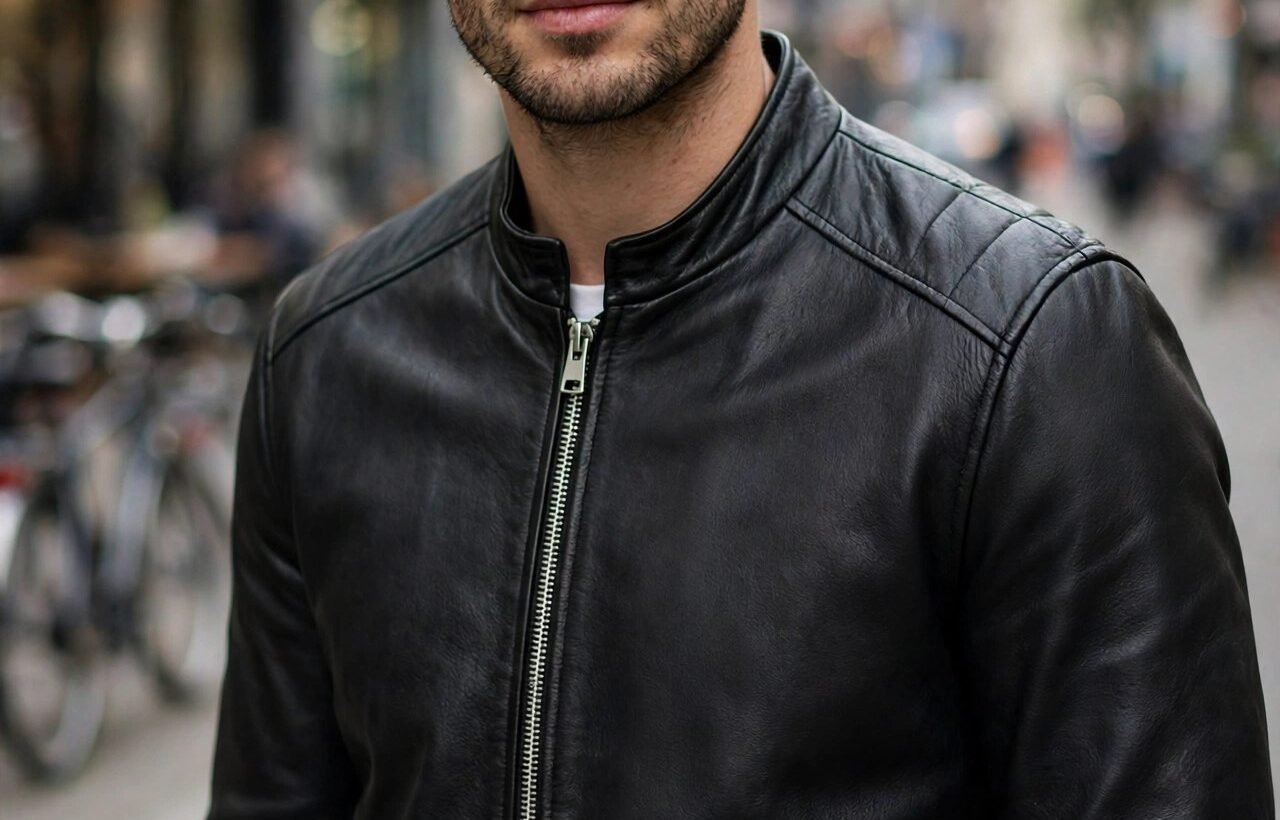
Zip it over the thickest layer you will actually wear underneath. A jacket bought for summer over a t-shirt needs less room than one bought for winter over a knit. Close the zipper fully and look at the front. It should lie smooth, without deep horizontal creases pulling from the zip toward the armpits, without the zipper tape bowing outward, and without an X-shaped pull across the chest. A few natural folds are normal — leather is a stiff material and new jackets crease — but strong tension lines are the jacket telling you it is too small.
Then do the flat-hand test. Slide a flat hand — not a fist — between the zipped jacket and your chest. It should fit without forcing. If you cannot get a flat hand in, the chest is too tight. If a fist fits with room to spare, the jacket is too loose and will lose the close line that makes leather look deliberate rather than accidental. Take a normal breath while you do this: you should not have to suck in your chest or stomach to close the jacket, and the zipper should lie reasonably straight rather than being pulled into a bow shape.
Cross your arms while you are at it. If the back panel pulls tight or the shoulders resist, the jacket is too narrow across the back, whatever the front looks like. And if you are shopping online, remember the chest is the number that drives the size — our leather jacket size chart US/UK/EU gives the full conversion, so you can match your tape reading to the right size before you order.
Sleeves: End at the Wrist Bone
Sleeve length is the easiest fit point to judge and one of the easiest to get wrong, because sleeves that look perfect while you stand still in front of a mirror can become too short the moment you bend your elbows or reach forward.
With your arms relaxed at your sides, the cuff should reach the wrist bone, showing about a centimetre of shirt cuff. It should neither swallow your hand nor leave your wrist bare. A cuff that covers half your hand means the sleeves are too long — and unlike a shirt, a leather sleeve cannot be pushed up without ruining the line. A cuff that stops halfway up your forearm means they are too short, and no amount of breaking in will lengthen them.
Then check again with your arms moving. Raise both arms forward to shoulder height, as if you are reaching for a steering wheel or a shelf. Two things should be true: the cuff should not retreat far up your forearm, and the whole jacket should not lift off your hips. Motorcycle-inspired sleeves sometimes run a little longer than fashion sleeves, because your arms extend while you ride — that is a design choice, not a sizing error, and it is worth knowing before you judge a biker jacket by a café racer's standard.
Sleeve length is measured from the shoulder point down the outside of the arm to the wrist, with the arm relaxed and slightly bent. If you are between sizes and everything else fits, a slightly long sleeve is the fault to live with: sleeves can be shortened by a leather specialist, while shoulders cannot be fixed. But a sleeve that is several inches too short is a deal-breaker — send it back.
Waist and Hem: Length Is a Style Decision
Where the hem ends depends on the cut, so judge length against the style you bought, not against other jackets.
A biker or café racer should finish at or just below the belt line. These cuts are deliberately short — the shape depends on it — and a hem that hangs to mid-hip on a biker makes the whole silhouette wrong. A bomber sits at the top of the hip, where its ribbed hem can sit naturally and hold a little volume above the band. A leather blazer covers the seat, the way a wool blazer would. An oversized or relaxed style runs longer by design, usually a few centimetres below the hip, with the shoulder seam sitting slightly past your natural shoulder on purpose.
Check the length standing and sitting. Sit down with the jacket zipped: it should not ride up past your belt or dig into your waist, and it should not bind under your arms when you sit and reach forward. The waist itself should follow the intended silhouette of the style — clean and close on a café racer, fitted or slightly tapered on a biker, straight on a bomber. Whatever the style, a correctly fitting jacket should not pull at the hem or zipper when you move, and it should not leave loose fabric ballooning around your torso.
If you are torn between a leather coat and a leather jacket, length is the first difference that matters — our leather coat vs leather jacket guide breaks down when each one earns its place, because a coat that covers the seat and a jacket that ends at the belt are solving different problems.
Movement: The Test That Catches Everything Else
New leather resists. That is normal, and it is why the movement test is about binding and strain, not about stiffness. A new jacket will feel firm for the first few wears and then mould to your body — but it should never hurt, dig in, or fight the zipper.
Run this sequence with the jacket zipped, over the layer you will wear. Reach forward as if holding a steering wheel, then raise each arm above your head. The body of the jacket will lift a little — that is normal — but the shoulders should not bind, and the zipper should not feel stressed. Sit down: the jacket should stay put, not ride up or dig into your waist. Cross your arms: the back should stay smooth across the shoulder blades, without pulling tight. Walk ten steps and reach forward again: the sleeves should stay at your wrists, not climb up your forearms.
Mild resistance from new leather is fine. What is not fine is the jacket digging into your underarms, the collar being forced backward when you raise your arms, or the zipper feeling like it might give way when you move. Those are signs the jacket is too small in the shoulders or the back, and they will not improve with wear — the leather will soften, but the pattern will not grow.
Too Tight or Too Loose? The Signs at a Glance
Use this table as a quick reference when you are standing in front of the mirror, deciding whether to keep the jacket or send it back.
| Area | Good fit | Too tight | Too loose |
|---|---|---|---|
| Shoulders | Seam sits on the edge of the shoulder bone | Seam pulls toward the neck; diagonal drag lines | Seam drops far down the arm; shoulders collapse |
| Chest | Zips smoothly; a flat hand fits inside | Zipper strains; X-shaped pull; cannot breathe normally | A fist fits with room to spare; front balloons |
| Sleeves | Cuff ends at the wrist bone | Cuff rides sharply up the forearm when you move | Cuff covers much of the hand |
| Waist | Follows the style’s silhouette | Hem or zipper pulls and rides up when you sit | Loose fabric bunches around the torso |
| Length | Matches the jacket’s style | Looks unintentionally cropped | Overwhelms the intended shape |
A traditional fitted leather jacket should generally be snug rather than tight. Snug means shaped and secure, with the leather sitting close to the body and the silhouette clean. Tight means restrictive — the jacket fights you when you move, the zipper strains, and you are aware of it all day. Loose means the jacket wears you: the shoulders droop, the chest balloons, and the close line that makes leather look sharp disappears. When in doubt, trust the zipper test over the mirror test — a jacket that zips comfortably and lets you move is the right size, even if it feels closer than you expected.
Fit by Style: Biker, Bomber, Café Racer and Oversized
The same size fits differently in every style, because each cut is built for a different silhouette. Knowing what each style is supposed to do stops you from judging a bomber by a biker's rules.
A biker jacket is cut short and close, with an asymmetric zip and wide lapels. Buy your true size — sizing up makes the lapels flop and the belted waist sit wrong. If you are between sizes, go up only if you layer underneath, and check the shoulder seam first: on a biker it is the most visible seam on the jacket, and a dropped seam ruins the whole look.
A bomber is the most forgiving cut you can buy. Its elasticated waist and cuffs hide a size of difference, and its straight zip means the chest is the only number that really matters. Between sizes on a bomber, go down for a neat look or up for a relaxed one — both work, because the ribbed hem pulls the silhouette back in.
A café racer is minimal and straight, with a small collar and no lapels. It should fit like a shirt: close at the chest, clean at the shoulder, no pulling at the zip. Between sizes, go down — a loose café racer loses the clean line that is the whole point of the style. If you wear statement jewellery with a leather jacket, the café racer is the best partner for it, because its plain front gives the jewellery a clean backdrop.
An oversized or blazer-style leather jacket is deliberately a size or two up. Do not use the size chart for these the way you would for a fitted jacket — buy the size the brand recommends for the oversized look, and check the shoulder seam, which should sit slightly past your natural shoulder on purpose. The difference between an oversized jacket and a jacket that is simply too big is intention: the oversized one is cut wider in the body with the extra length to match, while a too-big fitted jacket just droops.
Men's Fit vs Women's Fit
The fit rules are the same for men and women — shoulders on the bone, chest zipped with a flat hand of room, sleeves at the wrist — but the sizing behind them is not. Women's leather jackets use dress sizes, not chest numbers, which is where most of the confusion comes from. A women's US 8 is a UK 12 and an EU 40, while a men's US 40 is a UK 40 and an EU 50. Always use the women's chart and match your bust measurement, not the letter: a women's M can sit a whole size apart between two brands.
Women's cuts also shape differently through the waist. A women's biker is often cut with a defined waist and a slightly shorter body, and cropped women's designs may finish above the hip where a men's equivalent ends at the belt. That is a design choice, not a sizing error — judge the hem against the style, and judge the shoulders and chest the same way for everyone.
For men, the most common mistake is buying by the letter instead of the chest measurement. A US 42 is cut for roughly a 41-inch chest, because a leather jacket needs a little ease over a shirt — so a 42-inch chest is a US 42, but the jacket itself measures a touch more. Our leather jacket size chart US/UK/EU lays out both the men's and women's tables, so you can check your own numbers rather than trusting the letter on the label. Our body shape outfit guide is also worth a look if you want the jacket to work with the rest of your wardrobe, not just on its own.
Will Leather Stretch? What Breaking In Really Does
This is the question that decides more returns than any other, so it deserves a straight answer. Leather relaxes a little with wear, but it does not grow a size. The gain is roughly one to two centimetres of ease across the chest over months of wear, where the leather flexes — and shoulder width, sleeve length and the underlying pattern do not change at all.
That means two things. First, buy snug rather than tight: a jacket that is snug but comfortable when new will fit better after a few weeks, because the leather will mould to your body. Second, never buy a jacket that is tight and hope it stretches. A jacket that strains at the zipper, binds at the shoulders or digs in at the underarms on day one will still do all of those things in a year — it will just be a softer version of uncomfortable.
Breaking in is real, but it is a finishing process, not a fitting process. Wear the jacket often, let your body heat and movement do the work, and the creases will settle where you bend. Do not try to force it with stretching tricks or heat: a well-kept jacket lasts decades, and our guide to how to care for a leather jacket covers cleaning, conditioning and storage, because a neglected jacket cracks in a few winters while a cared-for one only gets better.
Between Sizes: Size Up or Size Down?
Most people land between sizes at least once, and the right answer depends on three things: what you layer, what your shoulders say, and what cut you are buying.
Size up if you plan to layer. A chunky knit, a hoodie or a thick sweater under a leather jacket needs a full size of extra room — a jacket that fits perfectly over a t-shirt will be unwearable over a sweater. Size up if your chest and your shoulders point to different sizes, because the shoulders decide: a jacket that fits your chest but pinches your shoulders is the wrong size, and the larger size is the one to take. And size up if you are between sizes on a slim-fit cut, which is cut close by design and has no room to give.
Size down if you want the classic close biker fit, if you only ever wear a thin shirt underneath, or if you are between sizes on a relaxed or oversized cut, which already carries extra room. Leather moulds to the body over the first weeks of wear, so a slightly snug new jacket that zips comfortably will fit better in a month than a loose one will.
When in doubt, order both sizes if the shop offers free returns, and keep the one that passes the shoulder test. A jacket you return costs you a parcel; a jacket you keep in the wrong size costs you the price of the jacket. Before you spend, our cost-per-wear calculator is worth a look too: a jacket that fits perfectly and gets worn a hundred times costs less per wear than a cheap one that sits in the wardrobe.
Trying It On: The Five-Minute Check
Whether the jacket arrives by post or you are standing in a shop, run this check before you commit.
Put it on over what you will actually wear under it, zip it up, and look at the shoulders in a mirror: the seam on your shoulder point, no droop, no pull. Sit down: the jacket should not ride up past your belt or dig into your waist. Raise both arms above your head: the body should lift a little but the shoulders should not bind. Cross your arms: the back should not pull tight across the shoulder blades. Walk ten steps and reach forward: the sleeves should stay at your wrists.
Then take it off and check the leather itself. A good jacket feels supple, not stiff or plasticky, and the lining should be smooth with no loose threads at the seams. If you are unsure how to look after the leather once it is yours, our guide to how to care for a leather jacket covers cleaning, conditioning and storage, because a well-kept jacket lasts decades and a neglected one cracks in a few winters.

Where to Find Leather Jackets That Fit
Once you know how a leather jacket should fit, buy from a seller that lists real measurements — chest, shoulder, sleeve and length — for every jacket, not just a letter. Small-batch and handmade sellers are often better here than big brands, because they measure each jacket rather than printing one generic chart for the whole range.
Abyzel Couture on Etsy stocks leather jackets and corsets in a full size range, with real measurements on the listings — a good place to check your new size against an actual jacket before you buy. Vintaaera on Etsy stocks leather jackets too, including classic biker and café racer cuts that follow the standard US/UK/EU chart in this guide. Before you buy, check the listing's own size chart against your measurements: the numbers in this guide are the standard, but the listing is the jacket you will actually receive. If you want to see how different cuts look in real outfits first, our guide to the best leather jackets for men is a good place to start.
One last tip before you order: write your five measurements down and keep them in your phone. Chest, shoulders, sleeve, waist, back length. The next time you shop for a leather jacket — or a coat, or a blazer — you will have the numbers ready, and you will never have to guess a size again. And if the jacket is the start of a new outfit rather than the end of it, our capsule wardrobe planner shows how one good leather jacket anchors a whole rotation.
FAQ: How Should a Leather Jacket Fit?
How should a leather jacket fit on the shoulders?
The shoulder seam should sit on the edge of your shoulder bone, where the flat top of your shoulder turns down into your arm. A seam sliding down the upper arm means the jacket is too big; a seam pulling toward your neck, with diagonal drag lines, means it is too small. Shoulders are the hardest part to alter, so get them right first.
Should a leather jacket be tight or loose?
Close, not tight. It should zip up without pulling, with room to slip a flat hand — not a fist — between the zipped jacket and your chest. Leather moulds to your body with wear but does not stretch at the chest or shoulders, so buy the fit that is comfortable on day one.
How long should leather jacket sleeves be?
The cuff should end at the wrist bone with your arms relaxed, showing about a centimetre of shirt cuff. Check again with your arms raised forward: the cuff should not retreat far up your forearm. Motorcycle-style sleeves may run slightly longer because your arms extend while riding.
Where should a leather jacket end?
It depends on the style. A biker or café racer should finish at or just below the belt line, a bomber at the top of the hip, and a leather blazer should cover the seat. Check the length standing and sitting — the jacket should not ride up past your belt when you sit.
How do I know if my leather jacket is too small?
Zip it up over the layer you will wear. If the zipper strains or bows, if there are deep horizontal creases pulling from the zip toward the armpits, if you cannot slide a flat hand inside the chest, or if the shoulders bind when you reach forward, it is too small. Leather will not stretch enough to fix any of these.
Do leather jackets stretch over time?
They soften and mould to your body, gaining roughly one to two centimetres of ease across the chest over months of wear. Shoulder width and sleeve length do not change. A snug jacket that zips comfortably will fit better after breaking in; a tight jacket will stay tight, so size up instead of hoping it stretches.
Should I size up or down in a leather jacket?
Size up if you layer thick clothes underneath, if your shoulders point to the larger size, or if the jacket is a slim fit. Size down if you want a close biker fit, only wear thin layers, or the jacket is a relaxed or oversized cut. If the shop offers free returns, order both and keep the one whose shoulder seam sits on your shoulder point.
How should a leather jacket fit a woman?
The same way: shoulder seam on the shoulder bone, chest zipped with a flat hand of room, sleeves at the wrist bone. The difference is sizing — women's jackets use dress sizes, so a US 8 is a UK 12 and an EU 40. Match your bust measurement to the women's chart, not the letter, and judge the hem against the style: cropped women's cuts may finish above the hip by design.