
On this page
- How Long Does It Take to Break In a Leather Jacket?
- Step 1: Check the Fit Before You Start
- Step 2: Wear It — Short, Frequent Sessions
- Step 3: Move With Purpose
- Step 4: Condition It Lightly — After a Few Weeks, Not on Day One
- Step 5: Layer a Sweater Underneath to Stretch It Slightly
- Step 6: Hang It Right Between Wears
- Breaking In by Style: Biker, Bomber and Café Racer
- Stiff Spots: Collar, Elbows, Shoulders and Waist
- What NOT to Do: Shortcuts That Damage Leather
- When a Jacket Will Never Break In
- After the Break-In: Keeping It Supple
- Where to Find Leather Jackets Worth Breaking In
- FAQ: How to Break In a Leather Jacket
How to break in a leather jacket? Wear it often, move in it on purpose, and condition it lightly after the first few weeks. That is the whole method. A new leather jacket feels stiff because its collagen fibres are packed tight from tanning, and the only safe way to loosen them is the slow combination of your body heat, your movement, and time. There is no shortcut that does not risk the leather — but the slow way works on every jacket, and the jacket that comes out of it fits you in a way no jacket ever will straight off the rail.
Every real leather jacket goes through a break-in period. A lambskin fashion jacket may feel comfortable from the first wear and settle in a week; a thick cowhide biker can take a month of regular wear before the shoulders, elbows and waist stop fighting your movement. That stiffness is not a defect. It is the sign of full-grain leather that will last decades once it has moulded to you — the creases will settle exactly where your body bends, the shoulders will drop into your shape, and the jacket will start to look like yours rather than like a product photo.
This guide covers the method that works, the timeline for each leather type, the stiff spots to watch, and the popular shortcuts that damage leather permanently. If you have just bought a jacket, start here before you try anything clever with it.
How Long Does It Take to Break In a Leather Jacket?
The honest answer is that it depends on the hide. Thicker, denser leather takes longer; thin, soft leather takes less. The table below assumes you wear the jacket four or five times a week, for several hours at a time, moving normally — walking, driving, sitting, reaching. Passive wear stretches the timeline by two to four times, so a jacket worn only on occasional rides can take months to feel broken in.
| Leather type | Thickness | Wears to break in | Calendar time | Feels when new |
|---|---|---|---|---|
| Lambskin | 0.5–0.8 mm | 5–10 wears | 1–2 weeks | Soft and supple, comfortable from day one |
| Goatskin | 0.6–1.0 mm | 10–15 wears | 2–3 weeks | Flexible but noticeably stiff at shoulders and elbows |
| Cowhide | 1.0–1.4 mm | 15–20 wears | 3–5 weeks | Firm and structured, rigid at shoulders, elbows and waist |
| Horsehide | 1.2–1.6 mm | 20–30 wears | 4–8 weeks | Extremely stiff, dense, needs deliberate effort |
Two things matter more than the numbers. First, break-in is measured in wears, not days on a hanger — a jacket hanging in your wardrobe is not breaking in. Second, what changes is suppleness, not size: leather relaxes roughly one to two centimetres of ease across the chest with wear, but shoulder width and sleeve length do not change at all. That is why the fit check comes before any of the rest — if the shoulders are wrong on day one, they will still be wrong in a year, and no amount of wearing will fix them. Our guide to how a leather jacket should fit walks through the five-point test to run before you commit to keeping a jacket, and the leather jacket size chart US/UK/EU gives the full conversion so you can check your own measurements against the size you bought.
Step 1: Check the Fit Before You Start
Breaking in softens leather; it does not make a jacket a size bigger. Before you put in three weeks of wear, make sure the jacket is worth breaking in.
Zip it up over the layer you will usually wear underneath — a t-shirt in summer, a sweater in winter — and check the shoulders first. The seam should sit on the edge of your shoulder bone. If it pulls toward your neck, or you see diagonal drag lines running from the seam toward the chest, the jacket is too small in the shoulders, and that will never improve. Cross your arms: if the back panel pulls tight across your shoulder blades, the jacket is too narrow across the back. Reach forward as if you are holding a steering wheel, then raise both arms above your head. Mild resistance from new leather is normal. Binding, digging at the underarms, or a zipper that feels like it might give way is not — those are signs of a jacket that is too small, not a jacket that needs breaking in.
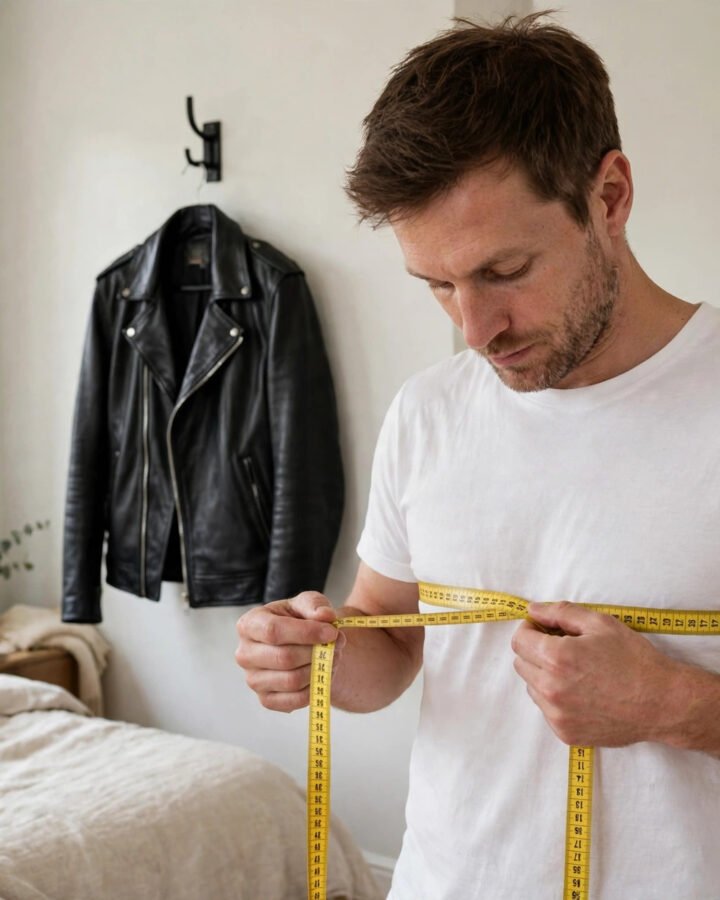
Do this check while you are still inside the return window. A jacket that fails the shoulder test should go back, whatever the shop’s break-in advice says. If everything passes and the jacket only feels stiff, you have a break-in job, not a sizing problem — and the rest of this guide is for you. If you are shopping for your next one, our guide to how to measure yourself for the perfect leather jacket shows how to take the five measurements that matter before you order.
Step 2: Wear It — Short, Frequent Sessions
Regular wear is the most effective and safest break-in method there is, because it applies all three softening forces at once: body heat, directional movement, and moisture vapour from your body. Your skin runs at roughly 33–37°C, and that gentle warmth makes the collagen fibres in the leather more pliable, so they shift a little with every move you make. No external heat source is needed — your body is the heat source, and it never gets hot enough to dry the leather out.
For the first few days, wear the jacket indoors for an hour or two at a time. Cook in it, sit at your desk in it, reach for things on high shelves. Short, active sessions do more than one long, static stretch: an hour of moving around the house puts more useful flex into the elbows and shoulders than a whole day of sitting still in it. Staying indoors also keeps you inside the return window while you decide the fit is right.
Then wear it out as much as you can. Walking, driving, carrying a bag, riding — everyday movement creates the bends that matter, and it creates them in the right places. The creases that form at your elbows and across your back will be your creases, in exactly the spots where your body bends, which is what makes a broken-in jacket look natural rather than artificially distressed. Aim for four or five wears a week, several hours at a time, and a cowhide jacket will reach most of its final suppleness in two to four weeks. A lambskin jacket gets there in a week or two.
The one thing wear cannot do is hurry. If you only wear the jacket once a week, expect the timeline to stretch to two or three months. The jacket is not being stubborn — it is simply waiting for the hours.
Step 3: Move With Purpose
You can speed the process up without touching a product, by giving the stiff panels deliberate movement. Think of it as exercise for the jacket: short sessions of flexing the areas that resist you most.
Bend and straighten your arms slowly, ten times, letting the elbow panels crease and release. Roll your shoulders forward and back. Twist your torso side to side with the jacket zipped. Reach both arms forward, then above your head, and let the back panel stretch across your shoulder blades. Do this for a few minutes whenever you put the jacket on, and again when you take it off.
You can also flex the jacket by hand before you wear it. Hold the sleeve at the elbow and bend it back and forth gently, the way you would flex a new belt. Roll the collar between your palms to soften the fold. Work the cuffs and the waistband the same way. Keep it gentle — you are encouraging the fibres to move, not forcing them. Targeted flexing is a supplement to wearing the jacket, not a replacement for it: the creases you make by hand will not match your body the way the creases from real wear do, but they take the worst of the stiffness out of the panels that fight you most.
What you are doing, in every case, is directional pressure: pushing the fibres into the positions your body will ask them to hold. That is the whole science of break-in, and it is why the jacket ends up fitting you specifically. A jacket broken in by its owner is shaped by that owner’s shoulders, elbows and stride — which is also why a second-hand jacket that someone else broke in never feels quite right on you.
Step 4: Condition It Lightly — After a Few Weeks, Not on Day One
A quality leather conditioner is the fastest safe way to soften stiff leather, because conditioners contain the same fatliquoring agents used during tanning: they penetrate the fibre structure and restore flexibility from the inside out. But timing matters. Condition after two or three weeks of regular wear, not on day one — the jacket needs its first wears to start forming its shape, and conditioner applied too early can soften the leather before the creases have set where your body wants them.
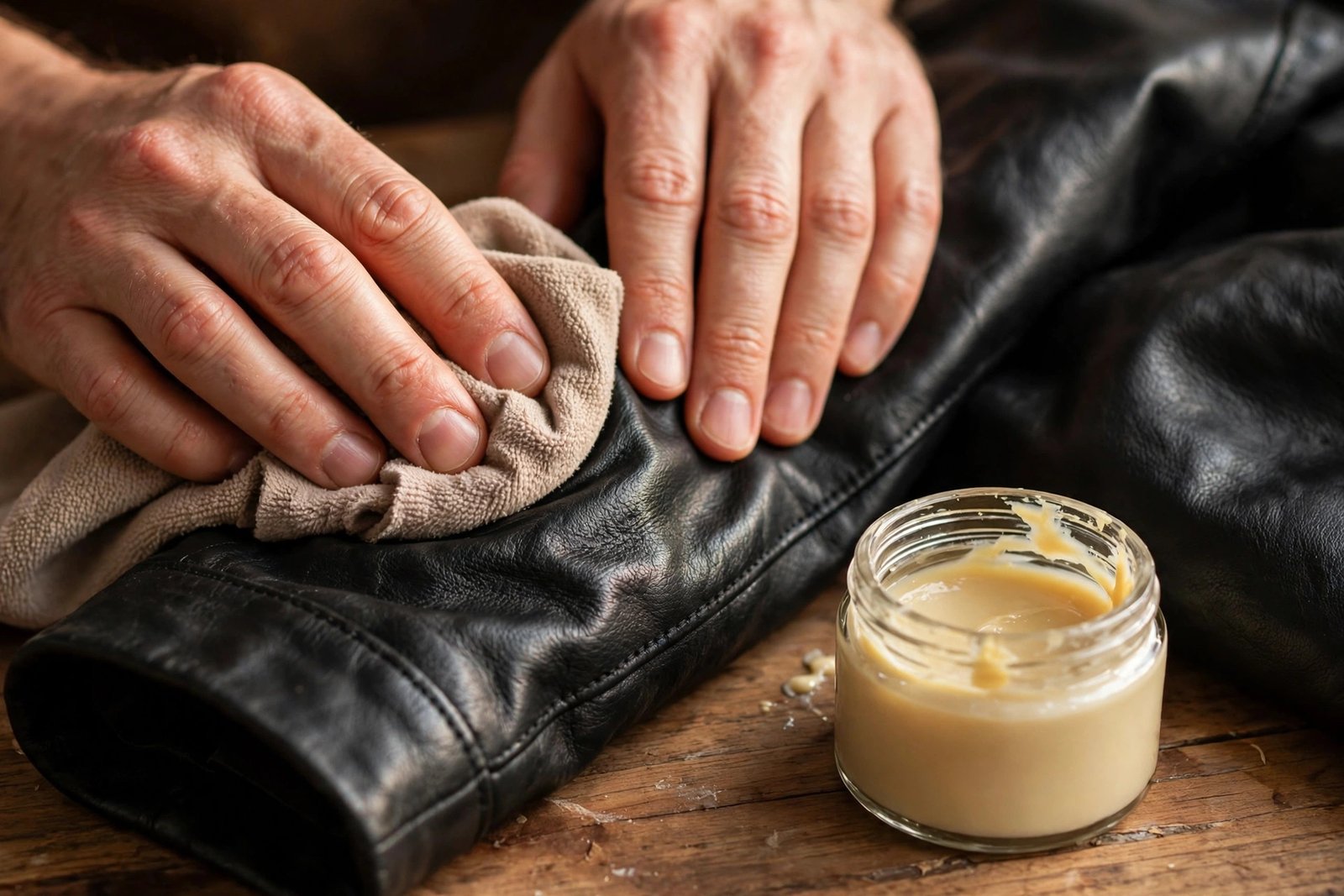
When you do condition, less is more. Test the conditioner first on a hidden spot, such as the inside of the hem facing, and wait a day to check for darkening or discolouration. Then apply a small amount to a clean, soft cloth — never directly onto the leather — and work it in with broad, circular strokes across the whole surface. Give extra attention to the stress points: elbows, collar, cuffs and the fold lines at the waist. Let it absorb for fifteen to twenty minutes, then buff off any residue with a dry cloth. One thin coat is plenty.
Over-conditioning is a real mistake: too much product leaves the leather greasy, attracts dirt, and can darken light-coloured leather permanently. For most jackets, conditioning once or twice a year is enough once the break-in is done; a jacket you wear daily may want it every three to four months. And choose the right product for the finish: a conditioner suited to smooth leather for a smooth jacket, and never a household oil. Olive oil and other kitchen oils can go rancid inside the leather over time, leaving odour and discolouration that no amount of cleaning removes. Our guide to how to care for a leather jacket covers cleaning, conditioning and storage in full, because a well-kept jacket lasts decades while a neglected one cracks in a few winters.
Step 5: Layer a Sweater Underneath to Stretch It Slightly
If the jacket is snug rather than tight — it zips comfortably, the shoulders sit right, but the chest feels close — wearing a thick layer underneath is the gentlest way to gain a little room. A chunky knit or a hoodie under the jacket pushes the leather out from the inside, applying even pressure across the chest and back, and the warmth of the extra layer adds to the softening effect.
Wear the layered combination for a few hours at home, moving normally. Do not force the zip closed over a layer that is clearly too thick for it: if the zipper strains or bows outward, the layer is too much and you risk stressing the zip tape and the seams. The goal is a snug, comfortable stretch, not a wrestling match. Two or three layered sessions are usually enough to notice the difference, and the gain is permanent — the fibres settle into the new position.
This trick is also the test that tells you whether to size up. If you plan to wear the jacket over a sweater all winter and it only fits over a t-shirt, no amount of break-in will create the room you need. Size up for layering, and break in the larger size instead. Our body shape outfit guide is worth a look if you want the jacket to work with the layers you actually wear, not just on its own.
Step 6: Hang It Right Between Wears
What happens between wears matters as much as the wearing. Hang the jacket on a wide, shaped hanger that supports the shoulders — the kind with broad, curved ends, not a thin wire hanger, which leaves dents in the shoulder line that take weeks to work out. Never fold a leather jacket into a drawer for long periods: folded leather creases in the wrong places, and those creases can become permanent.
Give the jacket air. Hang it in a ventilated wardrobe with space around it, not crushed between other coats. Let it dry naturally if it gets caught in light rain — never near a radiator or a heater. And leave it unzipped on the hanger, so the front panels hang straight and the zipper is not under tension while it rests.
Good storage is also what protects the break-in you have already done. A jacket that spends its off-hours folded or on a wire hanger is fighting its own shape every night, and you will feel it the next time you put it on.
Breaking In by Style: Biker, Bomber and Café Racer
The same jacket breaks in differently depending on its cut, because each style puts the stiffness in different places.
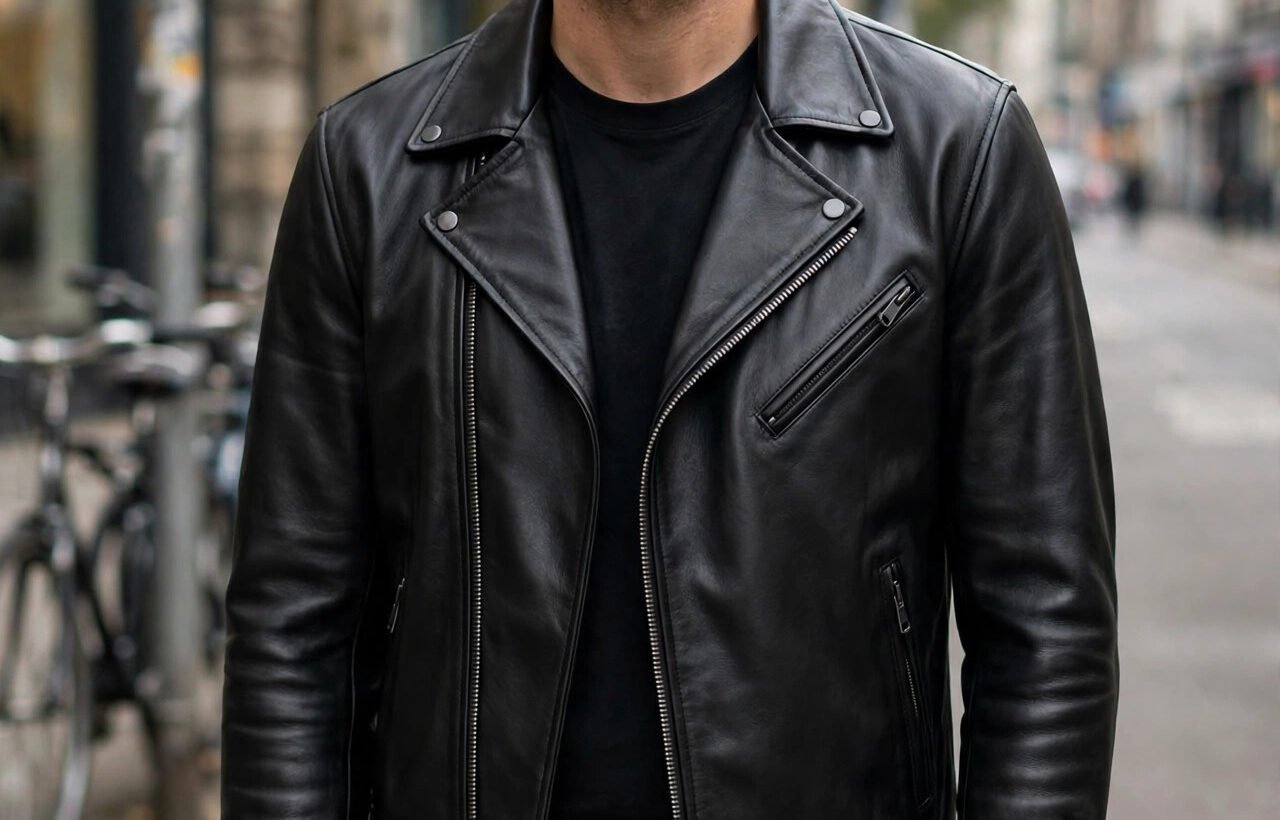
A biker jacket is the stiffest when new: its asymmetric zip, wide lapels and belted waist are all structured panels, and the shoulders are the most visible seam on the jacket. Expect the lapels to sit proud and the belt to feel rigid for the first two weeks. Flex the lapels by hand, roll them gently between your palms, and let the belt soften by wearing it fastened. Do not size up to escape the stiffness — a biker bought a size too large loses its whole silhouette, and the lapels will flop for the life of the jacket.
A bomber is the most forgiving cut to break in. Its elasticated waist and cuffs do the work of settling the silhouette for you, and its straight zip means the chest is the only number that really matters. The ribbed hem will feel tight for the first few wears and then relax. Between sizes on a bomber, the larger size breaks in just as easily as the smaller one, because the ribbing pulls the shape back in either way.
A café racer is minimal and straight, with a small collar and no lapels — so there is nowhere for stiffness to hide. It should fit like a shirt, close at the chest and clean at the shoulder, and the break-in is mostly in the elbow panels and the collar fold. Roll the collar gently by hand for the first week, and the clean line the style depends on will come. If you wear statement jewellery with a leather jacket, the café racer is the best partner for it once it has softened, because its plain front gives the jewellery a clean backdrop.
Stiff Spots: Collar, Elbows, Shoulders and Waist
Every jacket has one spot that resists longer than the rest. Knowing which spot, and what to do about it, saves you from fighting the whole jacket when only one panel needs attention.
The collar is the most common complaint on a new biker or café racer: it stands up, digs into the neck, and will not lie flat. Roll it gently between your palms for a minute before you wear the jacket, and fold it down and leave it folded overnight on the hanger. After a week of this it will start to hold the fold on its own.
The elbows are where the creases matter most, because they are the most visible sign of a broken-in jacket. Bend and straighten your arms deliberately, ten slow repetitions, whenever you put the jacket on. The leather will crease exactly at your elbow, and those creases are the patina that makes the jacket look lived-in rather than new.
The shoulders are the spot you should not try to fix. If the shoulders bind when you reach forward, the jacket is too narrow — that is a sizing problem, not a break-in problem, and no amount of flexing will change the shoulder width. Roll your shoulders and twist your torso to soften the back panel, but if the binding persists after two weeks, the jacket is the wrong size.
The waist and hem feel stiff on bombers and belted bikers because the band is elasticated or the belt is new. Wear the jacket fastened, sit down in it, stand up in it — the band will relax with movement, and the leather around it will follow.
What NOT to Do: Shortcuts That Damage Leather
The internet is full of break-in advice, and about half of it will ruin a jacket. Here is the shortlist of methods to avoid, and why each one causes damage that cannot be undone.
| Method | What it does | Why it damages leather |
|---|---|---|
| Soaking in water | Swells the fibres, then they dry stiff | Water strips the natural oils; the leather dries harder than before and can crack, shrink and stain |
| Hair dryer or direct heat | Forces the fibres to move while drying them out | Heat drives out moisture and oils, leaving leather brittle and prone to cracking |
| Tumble dryer | Heat plus tumbling | Combines heat damage with mechanical stress; can shrink and distort the jacket permanently |
| Rubbing alcohol | Dissolves surface oils fast | Strips the finish and the oils together, leaving pale patches and a dry, papery feel |
| Household oils (olive, coconut) | Seems to soften at first | Goes rancid inside the leather over time, causing odour, dark stains and sticky residue |
| Stretching machines or weights | Forces the leather wider | Stretches the fibres unevenly and can tear seams or distort the shape beyond the pattern |
| Wearing it in the rain to “mould” it | Soaks the jacket through | Same as soaking: strips oils, risks water stains, and the moulded shape sets stiff rather than supple |
The pattern behind every bad method is the same: forcing the fibres to move while dry, or stripping the oils that let them move. The safe methods all work the other way round — gentle heat from your body, slow movement, and lubrication from a proper conditioner. If a shortcut promises a broken-in jacket in an afternoon, it is promising damage, not speed.
One more to avoid: wearing a brand-new stiff jacket on a long motorcycle ride as its first outing. The riding position holds your arms forward for hours, and a jacket that has not yet softened will dig into your shoulders and underarms the whole way. Break it in around the house and on short trips first, and save the long ride for week three.
When a Jacket Will Never Break In
Some jackets never become comfortable, and recognising them early saves you weeks of pointless effort. The signs are consistent: the shoulders bind when you reach forward, the zipper strains or bows when you close it, you cannot slide a flat hand between the zipped jacket and your chest, or the jacket digs into your underarms when you move. These are sizing faults, and leather does not stretch enough to fix any of them — the gain is roughly one to two centimetres across the chest, and zero at the shoulders.
There is one other case: a jacket made from bonded leather or a thin corrected-grain hide that was stiff because it is coated, not because it is full-grain. Coated leather does not soften with wear the way full-grain does — the plastic-like surface layer holds its shape, and conditioning cannot penetrate it. If a jacket feels plasticky rather than leathery, and three weeks of regular wear have changed nothing, the material is the problem, not your patience.
In either case, the right move is the same: return or exchange it while you can, and use what you learned to buy the next one. Check the listing’s own size chart against your measurements before you order, and check the material description — full-grain or top-grain leather breaks in; bonded leather does not. Our leather jacket size chart US/UK/EU is the reference to use, and our cost-per-wear calculator is worth a look before you spend: a jacket that fits and gets worn a hundred times costs less per wear than a cheap one that sits in the wardrobe.
After the Break-In: Keeping It Supple
Once the jacket feels like yours, the job changes from breaking in to keeping it that way. Wear it regularly — leather that sits unworn for months stiffens again, and the creases set hard. Condition it once or twice a year, or every three to four months if you wear it daily, with a thin coat applied on a cloth and buffed off after twenty minutes. Clean it with a damp cloth when it gets marked, and let it dry naturally away from heat. Store it on a wide hanger, unzipped, in a ventilated wardrobe, and never folded.
A well-kept jacket only gets better with age. The creases deepen where you bend, the colour gains depth, and the fit settles into your shape so completely that the jacket becomes the one you reach for without thinking. That is the payoff for three weeks of patience: a jacket that looks like it was made for you, because in every way that matters, it now is.
If the jacket is the start of a new outfit rather than the end of it, our capsule wardrobe planner shows how one good leather jacket anchors a whole rotation, so the jacket you broke in becomes the piece everything else is built around.

Where to Find Leather Jackets Worth Breaking In
A break-in is only worth doing on a jacket made from real, full-grain leather, sold by a seller that lists real measurements. Before you buy, check that the listing gives chest, shoulder, sleeve and length for the actual jacket — not just a letter size — and that the material is stated as full-grain or top-grain leather.
Abyzel Couture on Etsy stocks leather jackets and corsets in a full size range, with real measurements on the listings — a good place to check your new size against an actual jacket before you buy. Vintaaera on Etsy stocks leather jackets too, including classic biker and café racer cuts that break in the way this guide describes. Compare the listing’s own size chart against your measurements before you order: the numbers in this guide are the standard, but the listing is the jacket you will actually receive. If you want to see how different cuts look in real outfits first, our guide to the best leather jackets for men is a good place to start.
FAQ: How to Break In a Leather Jacket
How long does it take to break in a leather jacket?
It depends on the hide. Lambskin takes 5–10 wears (1–2 weeks), goatskin 10–15 wears (2–3 weeks), cowhide 15–20 wears (3–5 weeks), and horsehide 20–30 wears (4–8 weeks), assuming four or five wears a week. Passive wear stretches those timelines by two to four times.
What is the fastest safe way to break in a leather jacket?
Wear it often in short, active sessions — an hour or two of moving around at home does more than a day of sitting still — and condition it lightly after two or three weeks of wear. Body heat and movement soften the fibres; the conditioner lubricates them so they flex instead of grinding.
Can I use a hair dryer to break in a leather jacket?
No. Direct heat drives moisture and oils out of the leather, leaving it brittle and prone to cracking. Your body heat is the only heat a jacket needs — it warms the fibres gently without ever drying them out.
Should I soak my leather jacket in water to break it in?
Never. Soaking swells the fibres and strips their natural oils, and the leather dries stiffer than before, with a risk of shrinkage, cracking and water stains. A light rain caught while wearing the jacket is fine if you let it dry naturally away from heat; deliberate soaking is not.
Does leather stretch when you break it in?
A little, in the right places. Leather relaxes roughly one to two centimetres of ease across the chest with wear, where the fibres flex. Shoulder width and sleeve length do not change at all, so buy for the shoulders and never buy a tight jacket hoping it will stretch.
How do I soften a stiff leather jacket collar?
Roll the collar gently between your palms for a minute before you wear the jacket, fold it down and leave it folded overnight on a wide hanger, and repeat for the first week. It will start to hold the fold on its own. Do not use heat or water on it.
How often should I condition a leather jacket?
Once or twice a year is enough for most jackets, or every three to four months if you wear it daily. Apply one thin coat with a soft cloth, test on a hidden spot first, let it absorb for fifteen to twenty minutes, then buff off the residue. Over-conditioning leaves leather greasy and attracts dirt.
My leather jacket still feels stiff after a month — is something wrong?
Check two things. First, the fit: if the shoulders bind or the zipper strains, the jacket is too small and no amount of wearing will fix it. Second, the material: bonded or heavily coated leather does not soften with wear the way full-grain leather does. If the fit is right and the leather is full-grain, keep wearing it — a thick cowhide jacket can take five weeks of regular wear to feel fully broken in.